Menu
You've decided you need to hire an employee. There's a figure in your head, let us say £30,000, and you have worked out that the business can carry it. That figure is not the cost of employing someone. It is where the cost starts.
It is one of the most common gaps we see. A business owner does the sums on the salary, commits to the hire, and then discovers three other costs sitting on top of it. None of those costs are hidden but easy to miss when you have never done this before.
In the latest Business Success Conversation, Michael Carthy sat down with Lucy Strange, one of our client relationship managers, to work through what taking on an employee actually involves. Here is what came out of it.
You have decided you need to hire someone. You have settled on a salary. That number in your head is not the number.
Most hiring problems do not start with the hire, they start with the timing. If you plan ahead you are not getting to the stage where you are extremely busy and you need to rush. Rushing is how people end up with the wrong person in the role.
If you wait until you are drowning, you will pick from whoever is available rather than whoever is right. You will skip steps and talk yourself into a candidate because the alternative is another month of doing everything yourself.
Planning the hire earlier does not commit you to making it, and buys you the time to do it properly when you do.
Alongside the salary, there are three costs to budget for:
Employer's National Insurance
You pay National Insurance on your employee's earnings above the secondary threshold. This is an employer cost, separate from the National Insurance the employee pays out of their own wages.
Pension contributions
If the employee is eligible for automatic enrolment, you must contribute a minimum percentage of their qualifying earnings into a workplace pension.
Holiday pay and statutory sick pay
Your employee accrues paid holiday, and you may need to pay statutory sick pay. Both mean paying someone during time they are not working, which is straightforward to plan for and awkward to discover halfway through a quarter.
Rates and thresholds change, usually at the Budget, so always check the current figures before you commit. The point is not the exact percentages. The point is that the salary is not the whole number, and your cash flow forecast needs to reflect that.
1. Setting up the payroll scheme too late
HMRC need to be informed before the first payment is made to an employee, not after it. This one catches people out constantly, because it is counterintuitive. You have found the person, agreed the start date, and the admin feels like something to sort out once they are in. It is not.
2. Treating someone as self employed when they are really an employee
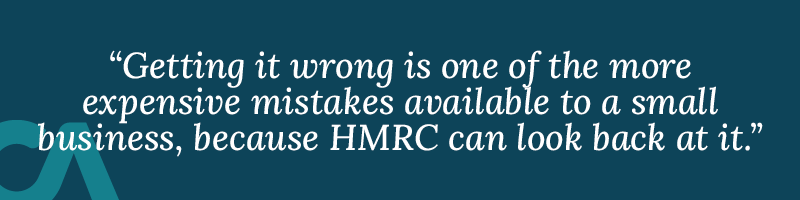
Whether someone is employed or self employed is not a matter of what you both agree to call it. It depends on the reality of the working relationship. Getting it wrong is one of the more expensive mistakes available to a small business, because HMRC can look back at it.
3. Leaving the extra costs out of the cash flow
If your forecast has the salary in it and nothing else, your forecast is wrong. Employer's National Insurance and pension contributions are real money leaving the business every month.
PAYE (Pay As You Earn), in practice means you calculate your employee's tax and National Insurance before you pay them, and deduct it from their gross pay.
So the £30,000 you agreed is what they earn, not what lands in their account. You are responsible for working out the difference, deducting it, and paying it over to HMRC on time. That is what a payroll scheme is for, and it is why it needs to exist before payday rather than after it.
Yes, with two conditions: They need to be doing a genuine role in the business, and they need to be paid a commercial rate for the work they actually complete.
If you meet those conditions the tax treatment is the same as it would be for anybody else. Failing them will give you a problem, because a wage paid for work that is not being done is not a wage.
It is simple. Have the conversation with somebody before you make the decision, not after.
If you run a director only business, you may have nobody to think this through with. That is a genuinely difficult position to make a first hire from, because the decision feels enormous and there is no one in the room to test it against.
The £30,000 is not a cheque you write on day one. It arrives in monthly instalments, and a well chosen hire starts contributing to covering it far sooner than most owners expect.
That does not make the decision easy but it does make it smaller than it feels.
Your first hire is one of the few decisions that changes what your business is, not just what it earns. It's a decision worth making with the full picture in front of you rather than a salary figure and a hopeful guess.
If you are weighing up a hire and you want to talk it through before you commit, get in touch. We will help you understand what it will actually cost, what it needs to earn back, and whether now is the right time.
Get in touch: carthyaccountants.co.uk/contact